


Extra shredder vital for business survival owner says
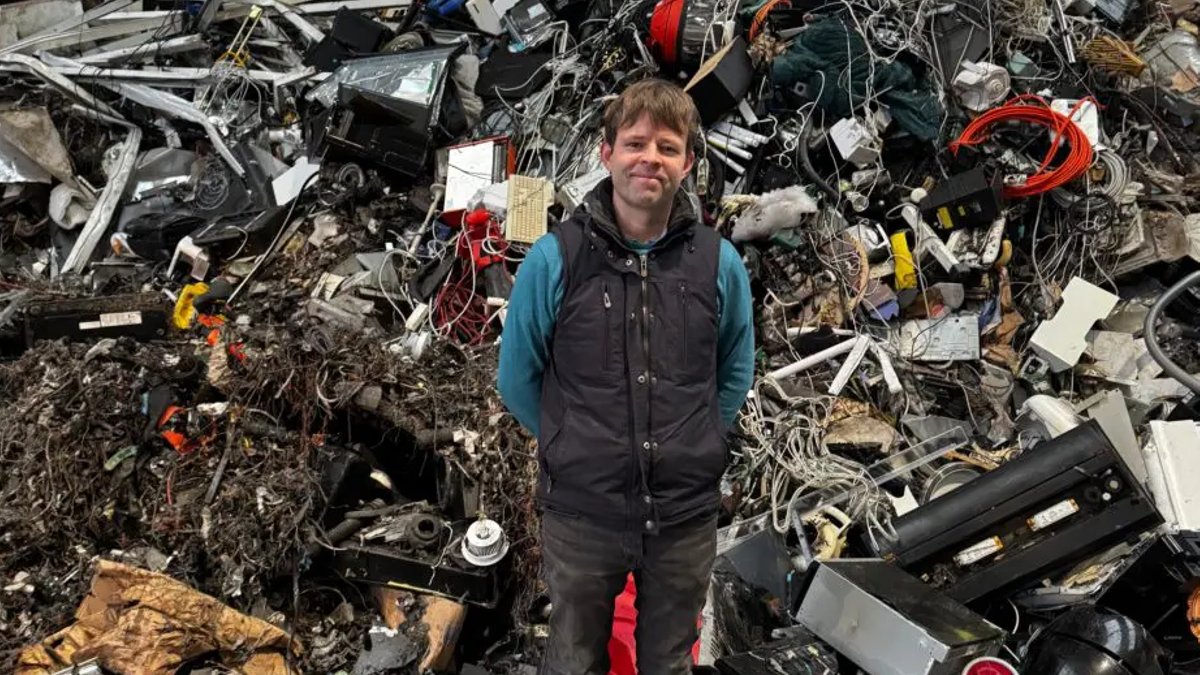
In 2023, a lithium battery fire destroyed the main facility at Behrendt Recycling in Neumünster, Germany. The damage came to EUR 2 million, and it took CEO Tammo Behrendt 18 months to rebuild. The experience forced a complete overhaul of the company’s fire safety plan.
Behrendt Recycling is a second-generation family business with a turnover of EUR 12 million. It processes electronic scrap — mostly small appliances and screens — and supplies smelters across Germany. The firm handles roughly 30,000 tons of e-scrap each year. Working with electronics means fire risk is never far away.
A small fire that grew into a disaster
Behrendt believes a battery stuck near a magnetic separator ignited the 2023 fire. It lit a conveyor belt, and at first it seemed manageable. “It was a small fire at first – not a big one,” he said.
But a series of wrong decisions made things worse. Firefighters insisted on handling heavy machinery themselves despite warnings. “We told them we could move it safely with our forklift,” Behrendt recalls. “But they said no – and ended up destroying parts of two buildings because the machine was too powerful.”
After stopping the visible fire, the firefighters cut electricity to the site. That unintentionally disabled all fire detection systems. “They assumed the system was backed up elsewhere, but it wasn’t,” he said. Thermal imaging showed no danger, but his team remained uneasy. “Our colleague said, ‘Something is still burning.’” Trusting their instincts, employees stayed overnight, manually checking the facility.
At 2 am, the hidden danger became visible. “They turned the lights on and the whole roof was already burning.” With no active detection, the fire had spread unnoticed. By the time the crew returned, half the building was lost. “That was the main fire,” Behrendt said. “At that point, nothing could stop it.”
Related: Bayram finds his calling in scrap recycling
The financial hit and a key survival strategy
Insurance covered only half the loss. “We had to pay EUR 1 million ourselves,” he said. The buildings were underinsured — annual 3% value increases had fallen far behind actual construction costs.
The company survived only because of a decision made years earlier to build a second pre-shredder for different material. “Without that, we would have lost all our customers; our business would be dead,” Behrendt said.
That kind of foresight is rare in an industry where margins are thin and fires are common. Many recycling facilities face the same battery hazard, but Behrendt’s case shows how quickly human error — from firefighters unfamiliar with the equipment — can turn a small incident into a catastrophic loss. The lesson is that even the best detection systems are useless if someone accidentally cuts the power.
Rebuilding with prevention in mind
The company completely redesigned its plant layout. “We lifted all equipment at least two meters above the ground,” Behrendt explained, allowing thorough cleaning at the end of every shift.
Before, dust and flammable residues accumulated under conveyors. “If something starts smoldering in dust, you may not see it and it can ignite hours later. Now that we can clean everything daily, the only thing left that can burn is the rubber belt itself.”
Another focus is identifying critical risk points. “The biggest danger is where material comes to rest,” he said. A hot battery moving along a conveyor does nothing until it stops. To address this, Behrendt installed infrared cameras and automated water cannons. “Every area where material stands still is under surveillance.”
If temperatures rise above a threshold, water is automatically sprayed at that exact spot. The system is already proving valuable. “We haven’t had a major fire since then but we still deal with burning batteries almost every day,” he added. “It is a huge relief to know the system is always watching. Trust me, you sleep much better at night.”
Related: Fake offices spark insurance concerns
The vaping problem and a mobile fire engine
A growing part of the problem is improperly disposed vapes. “These disposable e-cigarettes are a big issue,” Behrendt noted. “People throw them away without thinking but they contain lithium batteries which are very hard to detect.”
They often slip through sorting processes and increase fire risk. Despite all the technology, he says there is no simple fix. “You cannot stop a big fire once a pile of scrap starts burning. The only option is the building as quickly as possible.”
Speed is everything.
The company trains employees in firefighting. “Our goal is simple: we want to be faster than the fire department.”
That led to a practical innovation: a mobile firefighting system — a 1,000-liter water tank with a battery-powered pump, carried by a forklift. “If there’s a fire somewhere on the yard, you don’t wait. You just call a forklift driver: ‘bring the water’.” With forklifts constantly moving, response is almost immediate. “It’s like a fire engine on a forklift – just much faster. You don’t need to start a vehicle, you’re already there.”
In total, it invested EUR 500,000 in additional fire prevention measures on top of the rebuilding costs. For Behrendt, that level of spending is no longer optional. “There’s no other way to safely treat electronic waste. Those who don’t invest or don’t have the money to make sure their fire prevention system is up to date, simply won’t survive.” He summed up his approach this way: “The fire department should be jealous.”

Belgian recyclers protest rising battery fires


